
Did you know that the concrete truck market currently sits at $17.52 billion? It is expected to reach $40.05 billion by 2032. While the sales volume is positive, their impact on the road isn’t. Over the past decade, a 43% increase in heavy vehicle accidents has occurred. A huge chunk of this percentage is because of a truck’s blind spots. So, it makes a concrete truck blind spot solution more necessary than ever.
However, there is no single blind spot solution that you can purchase. The market is saturated with various options, which can be a good thing. This way, a truck driver can decide the right solution for their needs. So, let’s look at how to choose the best option for concrete truck blind spots.
Types of Concrete Truck Blind Spot Solutions
There are several types of concrete truck blind spot solutions. Let’s categorize them into three primary types:
Driver Monitoring Solutions
Driver monitoring solutions are not limited to the concrete truck’s blind spots. However, they can help drivers stay attentive on the road. It can allow for proactive actions like repositioning the side-view mirrors.
Usually, a supervisor monitors the driver using a camera or sensor-based system. It reads the driver’s behavioral patterns and eye movements to identify their current health and status. These systems can prevent dizziness and drowsiness in drivers, which often leads to not double-checking the surroundings. When a driver stays active, they can easily monitor their blind spots to avoid devastating accidents.
That said, a driver monitoring solution does not minimize or eliminate the threat of a concrete truck’s blind spots.
Sensor-based Solutions

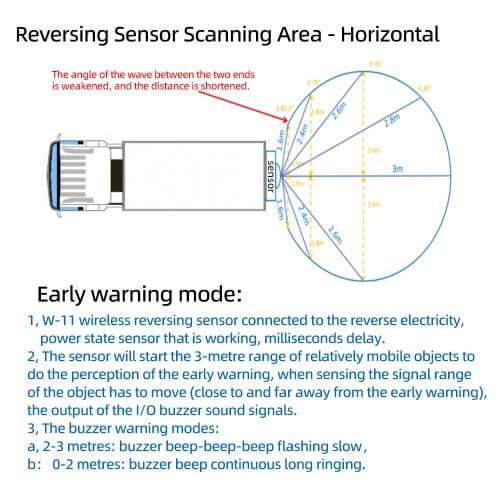
A sensor-based solution is a top choice for large vehicle drivers. These sensors are highly effective against blind spots. They cover a large area at the sides and behind the truck to monitor oncoming vehicles. In addition, they don’t require driver intervention or supervision to work.
Generally, sensor-based solutions for concrete trucks have an alert system, like a buzzer or LED lights. They offer visual or audible warnings to the driver after detecting a vehicle in the truck’s blind spots. So, the driver can quickly take action and avoid a collision.
There are two main types of sensors for these solutions: radar and ultrasonic.
- A radar sensor emits microwaves that bounce off nearby vehicles to alert the driver.
- Ultrasonic sensors emit sound waves that echo after hitting an object.
Here are the most important factors to consider in sensor-based solutions:
- Detection range: Ideally 3m from the sides and 9m behind for large vehicles like a concrete truck.
- Detection accuracy: ±1 to ±2 meters for the immediate rear and ±0.1 meters from the sides is recommended.
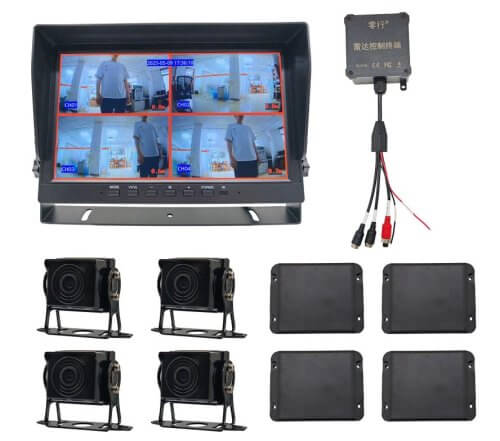
- Number of sensors: 4 sensors are good as they can cover all four blind spots. Otherwise, a set of 2 sensors will only cover the front and rear or the left and right sides.
Camera-based Solutions

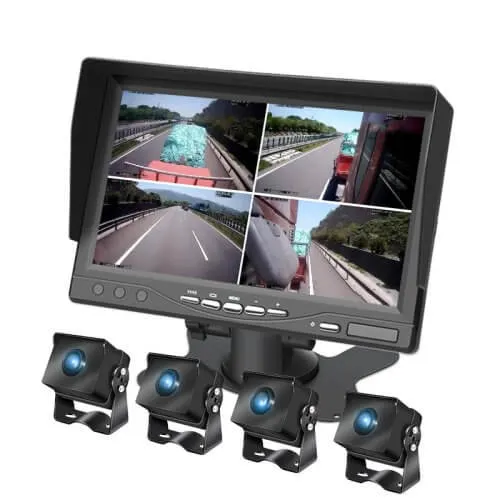
Camera-based solutions are also effective in minimizing a truck’s blind spots. They use high-quality and wide-angle lenses to cover large areas. Typically, there are two main types of camera devices for concrete trucks:
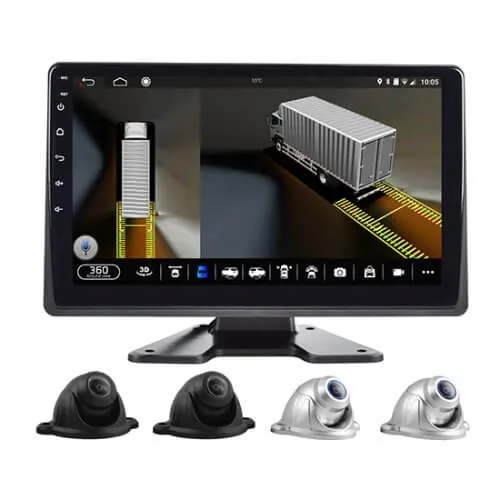
- Multi-camera systems: These cameras stay active throughout a truck’s journey. They provide a real-time view of the surroundings using four lenses placed strategically on all blind spots.
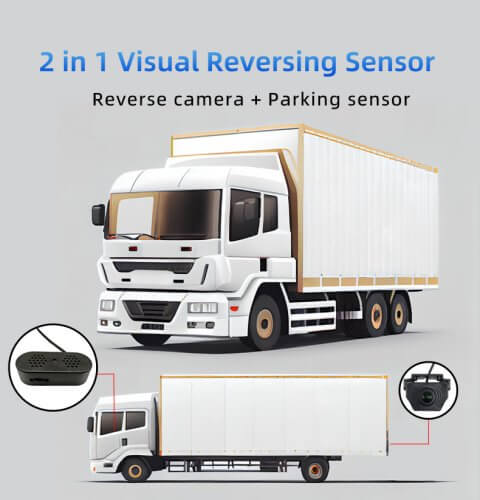
- Backup camera systems: A backup camera only activates when a truck is in reverse or parking mode. It only covers one blind spot, the immediate rear, using a lens installed on the truck’s license plate.
Camera systems use a display unit to provide real-time vision. The screen is mounted on the dashboard for accessible viewing. Moreover, this screen also serves as a control unit to change camera settings.
What are the most important factors to consider when buying a camera-based solution? Here’s the list:
- Video quality: Any video resolution over 720p or 1080p is highly recommended. Otherwise, you might miss minor details like smaller objects or pedestrians.
- Essential settings: A camera-based system MUST have brightness, exposure, night vision, and other settings to monitor the surroundings smoothly through night and day.
Which is the Best Concrete Truck Blind Spot Solution?

There’s no single best concrete truck blind spot solution. Let us tell you the best ones and their most appropriate applications. So, you can decide which one will work for you.
1. Blind Spot Detection System
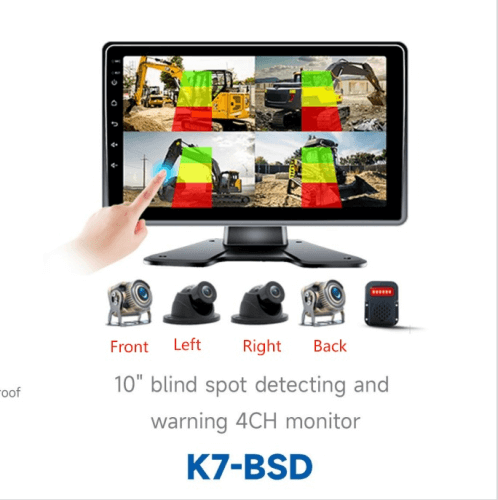
A blind spot detection, or BSD, system typically covers all four blind spots of a concrete truck. It uses sensors to monitor the truck’s surroundings and detect any vehicles, objects, or pedestrians. Moreover, BSD systems use audible, visual, or hybrid alerts. The alert mechanism is usually customizable, allowing a buyer to choose the system of their preference.
Usually, the buzzers and LEDs are installed on the truck’s A-pillar. That is why the BDS system is also called an A-pillar blind spot solution.
Another benefit of using a BSD system is its effectiveness in harsh weather conditions. These sensors work continuously during rain, snow, and fog. Additionally, they can resist outdoor elements like dirt and debris.
Best Application for Blind Spot Detection Systems
Blind spot detection systems are ideal for outdoor working environments like construction zones. They work effectively in all lighting conditions and resist dust, which is common in such sites.
2. Proximity Detection System
A proximity detection system (PDS) uses one or multiple sensors to detect an object’s distance from the concrete truck. This driving assistance system uses advanced algorithms to calculate the distance between a vehicle and an object or a pedestrian.
Moreover, it also considers other variables like an oncoming vehicle’s speed. This way, it can accurately notify the driver of a potential threat. On the surface, a PDS works almost like a blind spot detection system. However, some of its advanced models use automated features like emergency braking if the situation is too critical.
Best Application for Proximity Detection System
The best PDS application is in outdoor construction sites where vehicles are minimal, but many manual workers are present.
3. 4-Channel Camera System
A 4-channel camera system uses 4 lenses to minimize all four blind spots of a concrete truck. It provides real-time video output that a driver can view on the display unit. The driver can change the video settings to see all four outputs or one at a time.
Moreover, it uses powerful features like night vision to work in darker environments. A high-resolution display lets you view even smaller objects and pedestrians. Another benefit is that these cameras are connected to the truck’s power source. Hence, they don’t require manual activation. Instead, they turn on with the truck.
Best Application for a 4-Channel Camera System
4-channel camera systems work best for well-lit working environments where there are multiple objects and pedestrians.
4. Backup Camera System
A backup camera system also works with a display unit. However, this system only activates when it detects the truck’s reverse/parking mode. It covers the immediate rear blind spot of the truck, which causes about 25% of all fatal truck crashes.
Backup cameras are suitable for reversing and parking heavy vehicles in crowded urban spaces. Most of these systems generate guidelines on the screen that the driver can follow to navigate the truck safely. Additionally, backup camera systems use auto-brightness adjustment to work effectively in all lighting conditions.
Best Application for a Backup Camera System
The backup camera works as a cement mixer blind spot solution in crowded construction areas where reversing can be fatal for labor. However, it is better to use other blind spot solutions, like specialized mirrors, to cover other no-zones.
5. Driver Monitoring System
A driver monitoring system (DMS) can help stay attentive on the wheel. It uses active supervision from a workplace manager to prevent driver mistakes. However, a DMS might not directly impact the concrete truck’s blind spots.
It can only ensure a driver remains active so that they can check their surroundings using side-view and rear-view mirrors before making critical decisions. The primary purpose of a DMS is to prevent delays and accidents that cause operational inefficiencies and injuries/fatalities.
Additionally, a DMS can be integrated with other solutions like GPS navigation. This way, the supervisor can keep track of a driver’s position in real-time.
Best Application for a Backup Camera System
A DMS is ideal for supervising concrete truck drivers who are working long hours. It can prevent drowsiness, which is a common effect of continuous truck driving.
Conclusion
Now, you can easily choose the best concrete truck blind spot solution that fits your specific needs. It is also important to consider the budget factor. Solutions like BDS, backup cameras, and DMS are comparatively cheaper. Alternatively, PDS and 4-channel cameras are on the higher end of pricing due to their advanced, automated features.
Have you decided which cement mixer blind spot solution you will buy? Consider buying from OYI Electronic. We provide flexible warranties, after-sales support, and online guidance for all driving assistant solutions. Plus, all our products are available at only factory prices. So, contact us today and get a free price quote for the concrete truck blind spot solution you want!
Related Products: